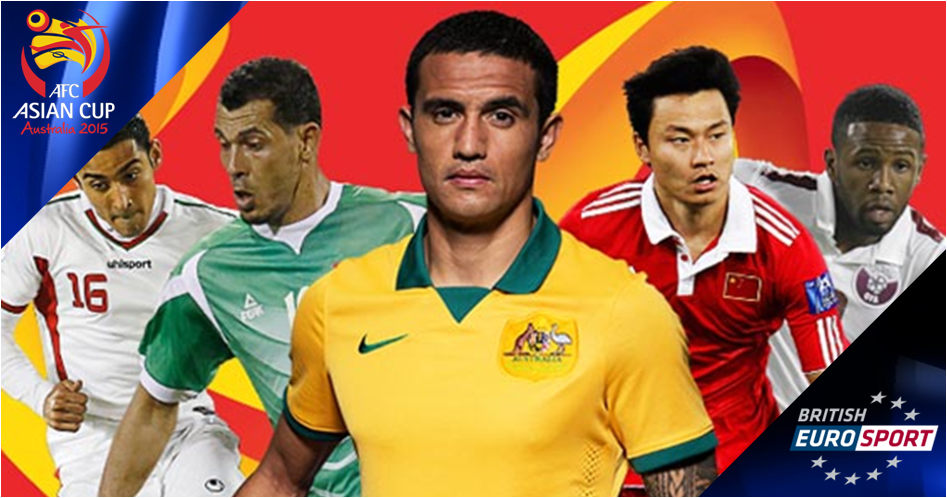
The biggest ever football tournament held in Australia takes place throughout January and British Eurosport has extensive live coverage of the 2015 AFC Asian Cup.
Asia’s premier international tournament has been running since 1956, making it four years older than UEFA’s European Championship, with South Korea winning a low-key competition in Hong Kong, with only the hosts, South Vietnam and Israel providing the competition.
Moving forward into 2015 and the competition is unrecognizable in its modern guise with sixteen teams competing every four years for what can be one of the more unpredictable continental tournaments in the international calendar.
Japan have won four of the last six tournaments but the shock victory of Iraq in 2007 proved that anything can happen.
Asian sides did not fare well in last year’s World Cup, with the four sides returning from Brazil with no victories and three draws from twelve matches between them, none making the knockout phase.
With stars such as Keisuke Honda, Omar Abdulrahman, Son Heung-Min and Mile Jedinak on display, the 2015 edition promises to be an entertaining and highly competitive tournament.
Australia, who moved from the Oceanian confederation to compete in Asia after the 2006 FIFA World Cup, are well-fancied and are second favourites to lift the trophy after Japan.
The hosts’ form, though, bodes ill. Although their positive style of play in the World Cup, under new manager Ange Postecoglou, was well regarded, they returned home having lost all three group matches in Brazil.
The Socceroos have won just one match in ten but, with home advantage, are nevertheless expected to fare well.
Australia face Kuwait in the opening match on Friday in Melbourne before facing Oman in Sydney then South Korea in Brisbane.
Predicting how Japan will do in tournament football is often a fool’s errand. They won the 2011 Asian Cup, beating Australia 1–0 in extra time in the Final, and thus qualified for the FIFA Confederations Cup in 2013, where they impressed with their intricate, possession-based play yet lost every game.
Their memorable match with Italy was a perfect summation of their problems: they played wonderful attacking football but struggled to defend against high-calibre opponents and lost 4–3.
The 2014 World Cup was a huge disappointment, beginning with a 2–1 defeat to the Ivory Coast having led at half time.
A dismal goalless draw with a Greek side who had Kostas Katsouranis sent off in the first half, yet arguably had the better of the second, put them in a perilous position and Colombia finished them off with a resounding 4–1 win.
Italian coach Alberto Zaccheroni has been replaced by the Mexican, Javier Aguirre. Japan will expect serene progress in Group D, in which they face Jordan, Iraq and Palestine.
South Korea, managed by the German Uli Stielike, finds himself in a similar situation to Aguirre.
The Koreans are capable of stylish football but are often found wanting at the back. The Asian Cup, however, is quite different from a World Cup and South Korea should advance from Group A with Australia.
Group C could be difficult to predict, with Iran up against Bahrain, Qatar and the United Arab Emirates. Iran famously gave Argentina a fright at the World Cup, with attackers Reza Ghoochanejhad and Ashkan Dejagah going close to putting them ahead before Lionel Messi’s brilliant last minute winner denied them what would have been a deserved point.
They had already held Nigeria to a draw but were eliminated, losing 3–1 in the last match to Bosnia & Herzegovina.
Qatar are on the long road to fielding a side at the 2022 World Cup which – in theory – they are set to host.
The 2011 tournament did not bode well: many games were played in front of small crowds despite extremely cheap ticket prices.
On the pitch, things are going rather better: Qatar are arguably the form side in Asia; won the Gulf Cup of Nations in November, beating Saudi Arabia in the Final; and are playing good creative football under young Algerian coach Djamel Belmadi.
The UAE could be dark horses as long as striker Ali Mabkhout – five goals in five games at the Gulf Cup – and playmaker Omar Abdulrahman are in form.
Abdulrahman is possibly the most sought-after player in Asian club football – he performed well at the 2012 Olympic Games, running Uruguay ragged in the first game – and a strong showing could see him seal a move from Al-Ain to a big club in Europe.
One thing is for sure: the UAE must surely fare better than in 2011, when they finished bottom of their group without scoring a single goal.
Group B contains no teams who qualified for the last World Cup but Saudi Arabia and Uzbekistan will be worth watching.
The Uzbeks are possibly on the wane after a period which saw them come close to qualifying for three World Cups – they lost the Asian repechage to Jordan on penalties in 2013 – while Saudi have a new generation of talented players coming through.
One to watch is Nasser Al-Shamrani, the striker who was bizarrely named Asian Player of the Year just hours before receiving an eight-match ban for spitting in the Asian Champions League Final.
China and North Korea, with World Cup appearances fading into the memory, could be awkward opponents but will do well to reach the quarter finals.
A touch of romance is brought to the tournament by the presence of Palestine, who won the AFC Challenge Cup last June to qualify for their first ever major tournament.
The difficulties the side face just in getting to Australia are well-documented, with players often prevented from joining up with the squad while the Gaza-based contingency have often had to train separately from those from the West Bank.
Japan are 8/1 on to beat them in their first match, while the side are 250/1 outsiders for the tournament, so for Palestine this championship is all about exposure and experience.
The tournament opens on Friday 9 January, with Australia taking on Kuwait in the opening match.
.

British Eurosport broadcasts the 16th edition of the AFC Asian Cup which will be hosted in Australia for the first time in the tournament’s history.
Asia’s equivalent to the European Championships will feature the top sides from across Asia, including Australia who joined the federation in time back in 2007, while the winning team will automatically qualifies for the FIFA Confederations Cup in 2017.
The opening game between Australia and Kuwait kicks off the pan-European channel’s coverage on the morning of Friday, January 9, which will be shown on delay from 11.00am on British Eurosport 2, with fourteen group matches scheduled to be broadcast live on the network.
Selected games later in the tournament will be shown on delay as they clash with British Eurosport’s extensive coverage of the Australian Open tennis, but the final on Saturday, January 31, will be broadcast live.
Live online streaming of British Eurosport’s coverage can be accessed via Eurosport Player (subscription required), plus there will also be additional reports and features via the British Eurosport website.
.
.

OFFICIAL WEBSITE STANDINGS TEAMS
Friday 9th January AUSTRALIA v KUWAIT (Group A) DELAYED: 11.00am-1.00pm British Eurosport 2Saturday 10th January SOUTH KOREA v OMAN (Group A) Kick-off: 05:00 LIVE: 5.00am-7.00am British Eurosport 2 UZBEKISTAN v NORTH KOREA (Group B) Kick-off: 07:00 LIVE: 7.00am-9.00am British Eurosport 2
Sunday 11th January UNITED ARAB EMIRATES v QATAR (Group C)
Kick-off: 07:00 LIVE: 7.00am-9.00am British Eurosport 2
Monday 12th January JAPAN v PALESTINE (Group D) Kick-off: 07:00 LIVE: 7.00am-9.00am British Eurosport 2 JORDAN v IRAQ (Group D) Kick-off: 09:00 LIVE: 9.00am-11.00am British Eurosport 2
Tuesday 13th January KUWAIT v SOUTH KOREA (Group A) Kick-off: 07:00 LIVE: 7.00am-9.00am British Eurosport 2 OMAN v AUSTRALIA (Group A) Kick-off: 09:00 LIVE: 9.00am-11.00am British Eurosport 2
Wednesday 14th January NORTH KOREA v SAUDI ARABIA (Group B) Kick-off: 07:00 LIVE: 7.00am-9.00am British Eurosport 2 CHINA v UZBEKISTAN (Group B) Kick-off: 09:00 LIVE: 9.00am-11.00am British Eurosport 2
Thursday 15th January BAHRAIN v UNITED ARAB EMIRATES (Group C) Kick-off: 07:00 LIVE: 7.00am-9.00am British Eurosport 2 QATAR v IRAN (Group C) Kick-off: 09:00 LIVE: 9.00am-11.00am British Eurosport 2
Friday 16th January PALESTINE v JORDAN (Group D) Kick-off: 07:00 LIVE: 7.00am-9.00am British Eurosport 2
Monday 26th January SEMI FINAL 1 Kick-off: 09:00 LIVE: 8.45am-11.00am British Eurosport 2
Tuesday 27th January SEMI FINAL 2 Kick-off: 09:00 LIVE: 8.45am-11.00am British Eurosport 2
Saturday 31st January AFC ASIAN CUP FINAL 2015 Kick-off: 09:00 LIVE: 8.45am-11.00am British Eurosport 2
.
.