
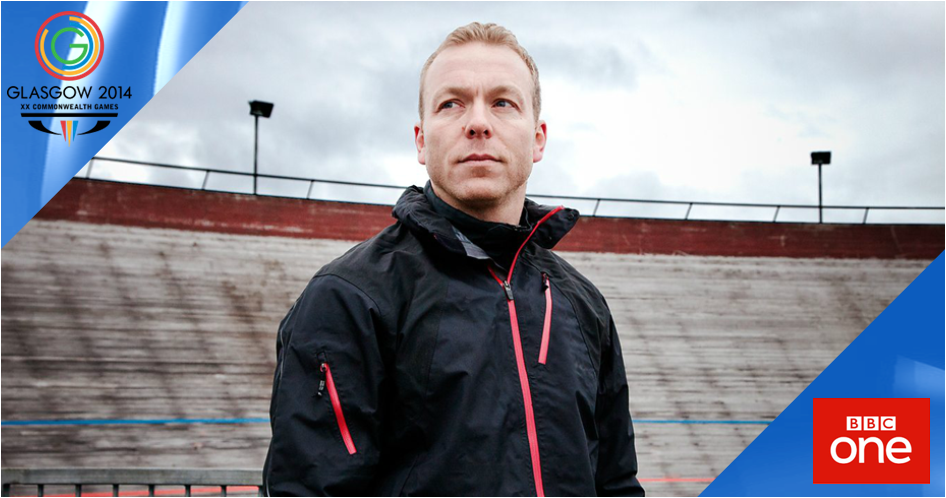
Sir Chris Hoy reveals how he went from a cycling club in Edinburgh to becoming Britain’s greatest ever Olympian in a new BBC documentary to air before the start of the Glasgow 2014 Commonwealth Games.
Britain’s greatest ever Olympian, winning six gold and one silver medal at four Olympic Games, compares his experiences with others, including legendary rower Sir Steve Redgrave, during the one-hour documentary How To Win Gold which goes out first on BBC One Scotland on Wednesday, July 16, with a nationwide repeat the following Tuesday evening.
Hoy’s amazing journey to becoming one of Britain’s most successful sportsmen took him from a cycling club in Edinburgh to the biggest stages in the world of sport.
He won a record-breaking six Olympic gold medals in his chosen sport before deciding to retire after London 2012, despite the lure of competing at the Glasgow Commonwealth Games two years after inside a velodrome named in his honour.
Now in this special documentary, the Scotsman looks at his journey and speaks to other outstanding medal-winning athletes to discover how they won gold.
Hoy himself doesn’t believe that he was simply born to be a champion, so how did he do it and how does his story compare with the other top athletes he meets in this revealing BBC film?
Contributions throughout the documentary come from former Wimbledon champion Andy Murray, heavyweight boxing legend Lennox Lewis, five-time Olympic rowing champion Sir Steve Redgrave, two-time Olympic swimming gold medallist Rebecca Adlington and Graeme Obree, the man know as ‘The Flying Scotsman’.
They all tell their story on what pushed them to the top of their game, while Hoy explains the physical and psychological process he underwent to make sure he was the best in his field.
Sir Steve Redgrave was picked out at school by a teacher for having big hands and feet to make him suitable for rowing. He pinpoints desire to succeed, outweighing skill level as the gold factor.
Meanwhile, Wimbledon champion Andy Murray puts proving people wrong as a factor in his own determination, and discusses the pressure of expectation and how he dealt with the nation’s hopes for him.
Swimming gold-medallist Rebecca Adlington, who won one of her two gold medals by a fingertip, talks about the tiniest manoeuvres and decisions that can make the difference between winning and losing.
Meanwhile, for boxer Lennox Lewis, who retired as the undisputed heavyweight champion of the world, it was all about tactics and psyching out the opposition.
For fellow cyclist Graeme Obree, the drive of fear of regret was the one thing that pushed him to his limit – and admits he would rather have died than let his opponent win the World Championships in 1995.
The film also hears from Hoy’s family and team, who talk about the highs and lows of the years of hard work and preparation, and also follow Sir Chris as he starts on his new goal, to race for a professional motor racing team.
As well his special documentary, Hoy will be part of the BBC Sport team covering the cycling events at the Glasgow 2014 Commonwealth Games, which starts with the opening ceremony at Celtic Park on Wednesday, July 23.
Commenting on his BBC Scotland film, Hoy says: “The success I had never stopped surprising me because I don’t think I was simply born a champion. I don’t think anyone is.
“I want to show you how champions are made, through endless hard work and determination, by victory and defeat, by brain as well as brawn, by great teams and amazing support.
“And if I can do it, anyone can, because we all start off with a chance of winning gold.”
Sir Chris Hoy: How To Win Gold premieres on BBC One Scotland a week before the Games opens, with a further nationwide showing on BBC One the day prior to the opening ceremony.
The documentary will also be available to view on-demand via BBC iPlayer for up to seven days after transmission.
.
Wednesday 16th July
Sir Chris Hoy: How To Win Gold
9.00pm-10.00pm BBC One Scotland
.
Tuesday 22nd July
Sir Chris Hoy: How To Win Gold (repeat)
10.45pm-11.45pm BBC One
(11.15pm in Northern Ireland / 11.45pm in Scotland)
.
.


