
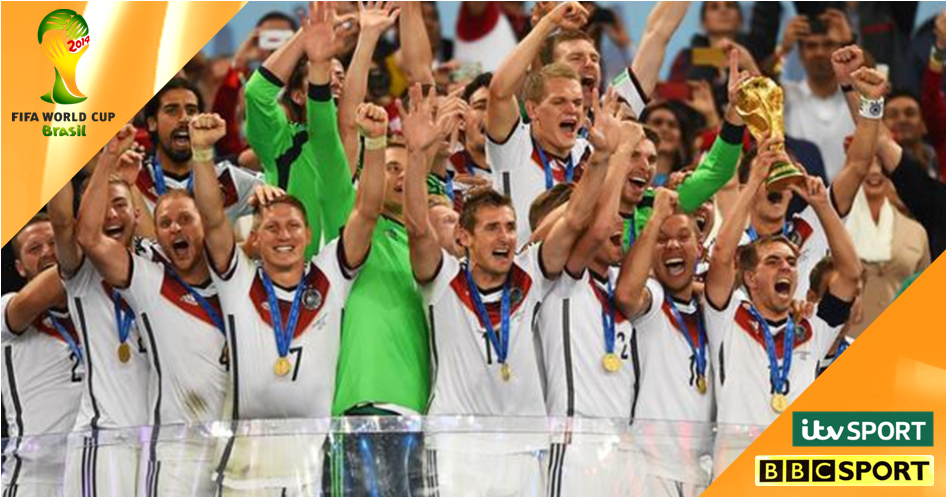
Germany’s thrilling extra time victory over Argentina in the 2014 FIFA World Cup was seen by a peak television audience of more than 20 million viewers across BBC One and ITV.
The vast majority of the UK audience for the biggest match in international football tuned in to watch the BBC’s coverage from the Maracana in Rio de Janeiro, where millions witnessed Mario Gotze’s stunning strike in the second period of extra time that secured the German’s fourth World Cup win.
Gotze’s World Cup-winning goal was seen by a peak of 16.7 million viewers on BBC One at around 10.30pm on Sunday night (July 13), while another 3.8 million viewers were watching at the same time over on ITV, with the commercial channel’s peak audience of 4 million coming just towards the end of normal time.
The peak audience across both channels for the match was 20.64m, more than 75% of the viewing population, and is the biggest UK TV audience since the closing ceremony of the London 2012 Olympic Games, broadcast on BBC One.
The whole match itself, which kicked off at 8.00pm, averaged 14.9 million viewers on BBC One and 3.6 million viewers on ITV, according to BARB overnight figures, which do not include audiences watching in pubs, bars and clubs, or online.
As is tradition at major international tournament finals when both broadcasters go head-to-head, the BBC secured another comprehensive ratings victory over rivals ITV, with a ratio of approximately four to one favouring the BBC’s uninterrupted coverage.
For the entire four-hour live broadcast of the final across both channels, which started an hour ahead of kick-off at 7.00pm, an average of 12.1 million tuned into BBC One, representing more than 50% viewing share, against 2.9 million on ITV.
The BBC’s coverage, which marked Alan Hansen‘s final appearance as a pundit, was fronted by Gary Lineker from its studio overlooking Copacabana beach in Rio de Janeiro, while match commentary was provided by Guy Mowbray and Mark Lawrenson.
To differ from the BBC’s formal-looking coverage of the final, ITV decided to locate its coverage on Copacabana itself with Adrian Chiles anchoring its live broadcast with a quartet of pundits including Martin O’Neill and Glenn Hoddle, with Clive Tyldesley and Andy Townsend providing match commentary from inside the stadium.
Compared to the 2010 World Cup final in South Africa, when Spain also needed extra time to beat the Netherlands 1-0, the BBC’s audience was actually lower this time around, with 12.7 million tuning in four years ago, while ITV’s average audience increased slightly from 2.8m in 2010 to 2.9m in 2014.
The BBC’s peak audience was also down on four years ago with 17.9 million watching in 2010, in contrast to the 16.7 million who saw the 2014 final.
Although still a comprehensive win for the BBC , the head-to-head viewer ratio was slightly better for ITV this time around compared to 2010, when the BBC had a match average of 15.1 million and ITV 3.3 million.
In Germany itself, their supporters broke national viewing records with a staggering 34.65 million watching the final live, representing of total of 86.3% of the viewing population.
Alongside strong TV ratings in all major markets, Germany’s World Cup final victory over Argentina also smashed global records on Twitter and has become the biggest sporting event in Facebook’s history.
.
.


