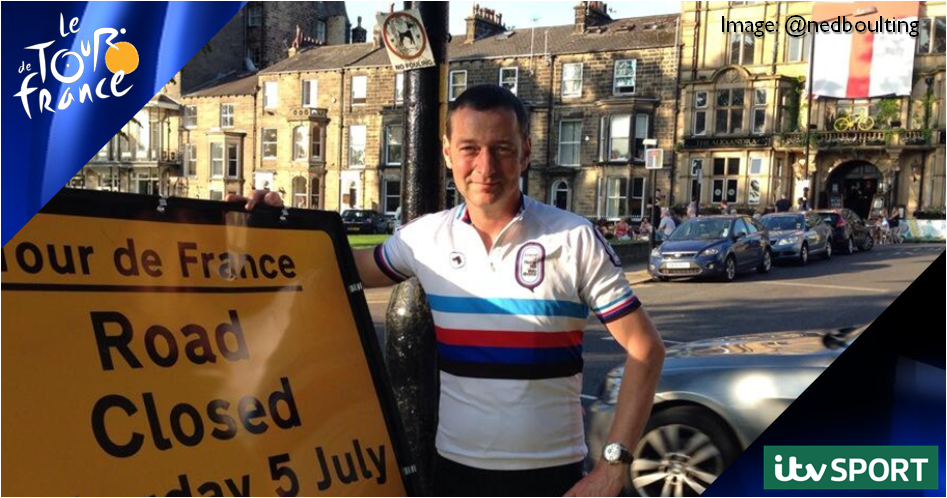
Britain turns yellow for three days this summer as the Tour de France ventures into Yorkshire for the first time and ITV’s roving reporter Ned Boulting will be at the heart of the action once again.
Having initially carved out a name for himself working as a reporter across ITV’s football coverage, Ned joined ITV’s Tour De France team in 2003 and has reported from the roadside at every edition of the famous race ever since.
This year’s Tour will be Ned’s 12th with ITV and alongside the annual French showpiece, he has also covered the Tour of Britain, Vuelta a Espana and the Women’s Tour the network, as well as continuing to work on other ITV sporting events such as Europa League football and PDC darts.
Away from broadcasting, Ned has also written books based on his Tour de France work and on his own personal experiences of cycling.
Prior to the Yorkshire Grand Depart, he gives Sport On The Box his unique perspective into what it’s like to cover one of the biggest annual sporting events in the world and his thoughts ahead this year’s race, which starts in Yorkshire on July 5 and concludes on the Champs-Élysées on July 27.
.
Follow Ned on Twitter: @nedboulting
.
SOTB: How excited are you about the return of the Tour de France to the UK?
Ned Boulting: The race coming to Yorkshire is an extraordinary turn of events, and represents recognition of the giant strides made by British cyclists over recent years
Having spent a lot of time in the county over the last few weeks, I know what it means to everyone up there, and how well prepared they are for it.
I think the Tour de France will be bowled over by the way the race is received in the UK and particularly on the first two stages.
.
What are your memories of the Tour’s last visit in 2007 and how different do you think Yorkshire’s Grand Depart will be compared to the two stages held here seven years ago?
The Grand Départ in London was a wonderful occasion that meant a huge amount to the cycling fan base in this country, but it didn’t punch through on a national level.
In fact, outside of the cycling ‘bubble’, most of the country was unaware it was happening at all, even in London itself.
Now, seven years later, and mainly thanks to both Mark Cavendish and Bradley Wiggins, everything has changed, and there can scarcely be anyone in the UK who isn’t aware that the race is starting over here.
.
Yorkshire is embracing the arrival of the Tour and no doubt there will be huge crowds on the roadside cheering on the riders. How much for you does this highlight the extraordinary rise of cycling in the UK over the past decade?
We’ve seen year on year growth in every aspect of the sport and our own viewing figures on ITV bear that out.
The ripple effect is felt on other races, too. The Tour of Britain attracts huge crowds every year, and large numbers of TV spectators, and the Women’s Tour, which was launched this year will also benefit form that precedent.
But none of this could shave happened without the serial success of the the British contingent at the Olympic Games, and then on the grandest stage of all, the Tour.
.
As for the race itself, a big talking point in the build-up has been the absence of Sir Bradley Wiggins from Team Sky’s line-up. How much of a loss is this to the Tour, particularly with first three stages being held in the UK?
It is a loss, in PR terms. For many people, he simply IS the Tour de France.
But I would urge people who have been deeply disappointed by his absence to look closely at the possible reasons why he’s not been selected, and to think about the important psychological make up a the nine man team over three weeks.
Can there really be two leaders? Besides, the beauty of the event is in its scale, and there are 198 riders on the start line all with interesting biographies and individual ambitions.
I urge you all to immerse yourself in the whole story, not just Team Sky.
.
You’ve been part of ITV’s Tour coverage as a roving reporter for over a decade now, covering the extraordinary highs and painful lows of this great event. How does the role compare to the other sporting events you work on?
Completely different. In cycling, as a TV journalist you feel very close to the narrative of the event.
The access you get is extraordinary, and by and large, the riders are extremely obliging in very trying circumstance.
Not only that, but when it comes to sniffing out wrongdoing, it is often the journalists who drive the agenda, and sometimes influence directly the outcome of the race, as we did in 2007 when Michael Rasmussen withdrew.
Compared to football, where the media are held very much at arm’s length, it’s a very rich, giving environment to work in.
.
What are the best and worst parts about covering the Tour from a broadcasting perspective?
Not knowing what’s going on. So much of cycling is hidden. Things happen on the road which are missed by the TV cameras, so there is a constant sense that we are not quite getting to heart of the matter. But in some ways, also that frustration is the attraction, too.
The days are long, the travelling can be very wearing. But the landscape you pass though is great compensation.
.
All the usual ITV on-air crew are back for this year’s Tour. What can we expect from this year’s coverage?
More of the same, I hope. We’ve been at it long enough to understand our various roles pretty well.
Chris and I have done our usual little films, and everything is in place ready to start.
We are also expecting to be joined by a special guest for the first three days, but I’m not sure I’m allowed to tell you who it is!
.
That special guest has been confirmed as David Millar, who will be part of the ITV team for the UK based stages. How much are you looking forward to working with him?
I always anticipated that one day I would end up working with David Millar.
He was my introduction to cycling, and his dramatic, controversial career has neatly coincided with my involvement in the sport.
David divides opinion, for sure, but there can be no doubt that he will offer genuine candour and insight into the race, as race he really should have been riding. I’m looking forward to it.
.
Prior to the Tour, you rode from London to Paris for The Unstoppables in aid of Beat Blood Cancer. What was this experience like and how did you fare?
I did OK. It brought out a competitive streak in me that I didn’t know I had. So here’s my little boast: I came 16th out of 230.
But it was a fantastic event, which raised a huge amount of money for a wonderful cause. You should all sign up for next year’s ride!
.
You’ve also written a new book about Britain’s growing obsession with cycling – On the Road Bike: The Search For a Nation’s Cycling Soul – Is this a trend you can see carrying on for years to come?
I don’t know, really. Sometimes I feel like we’ve hit a glass ceiling, but then something will happen which suggests there is plenty more to come. Let’s see.
What really matters more than anything, I think, is to get people back into the mindset that a bike is part of everyday life. Leave the car in the garage, and hop on a bike for a change. I promise you, it’ll change your life.
.
Finally, who do you think will be the main contenders at this year’s Tour and who have you backed to claim the yellow jersey?
I cannot split Contador or Froome. Maybe the Spaniard just has the edge, but Froome’s such a talent, and he’ll fight him all the way.
Don’t rule out someone quite unexpected taking the lead as we head toads the Alps. The first nine or so stages are wildly unpredictable.
.
.
.
Main picture courtesy of @nedboulting
.